Showing posts with label twins. Show all posts

Sunday, February 27, 2011

Book Review: Her Fearful Symmetry by Audrey Niffenegger

Photo taken from Goodreads

 Book Info

Title:  Her Fearful Symmetry 

Author:  Audrey Niffenegger
Publisher:  Scribner
Language: English
Format:  Hardcover 
Pages:  416 pages
ISBN-10:  1439165394
ISBN-13:  978-1439165393
Source:  Purchased, Booksale

Summary

From Goodreads:


"
Julia and Valentina Poole are semi-normal American twenty-year-olds with seemingly little interest in college or finding jobs. Their attachment to one another is intense. One morning the mailman delivers a thick envelope to their house in the suburbs of Chicago. From a London solicitor, the enclosed letter informs Valentina and Julia that their English aunt Elspeth Noblin, whom they never knew, has died of cancer and left them her London apartment. There are two conditions to this inheritance: that they live in it for a year before they sell it and that their parents not enter it. Julia and Valentina are twins. So were the estranged Elspeth and Edie, their mother.

The girls move to Elspeth's flat, which borders the vast and ornate Highgate Cemetery, where Christina Rossetti, George Eliot, Radclyffe Hall, Stella Gibbons and Karl Marx are buried. Julia and Valentina come to know the living residents of their building. There is Martin, a brilliant and charming crossword-puzzle setter suffering from crippling obsessive compulsive disorder; Marijke, Martin's devoted but trapped wife; and Robert, Elspeth's elusive lover, a scholar of the cemetery. As the girls become embroiled in the fraying lives of their aunt's neighbors, they also discover that much is still alive in Highgate, including - perhaps - their aunt.
 "

Review

I have been putting off finally reading this book for the longest time.  I was very intrigued by the synopsis of this book when I picked it up in the bookstore one day.  But because I already had a lot of books to buy that day, I decided to pass on it for the time being.  When I got home, I looked it up on the internet and found predominantly negative reviews for this second book by Audrey Niffenegger.  Disappointed, I thought it best to just forget about it.  Then a month or so after, I found a hardcover copy in my favorite secondhand bookstore and without thinking, took it to the cash register and purchased it.  Later, while thinking about the wisdom of my actions, I thought, What the heck, if I didn't like it, at least I did not pay that much for it.

And now, I can say, finding a copy of Her Fearful Symmetry in that secondhand bookstore was destiny.  In my opinion, this is one of the best books I have read so far.  

At its heart, this book is not just a simple ghost story, it is a story of human follies - wanting one thing but ending up with something else; wanting what you can never have; playing a joke on others but it turns out the joke is on you.  The ghost story in itself is an amazing sketch of the hilarity of the unachievable - you lay in wait for death, but as soon as it comes it eludes you again and you find that you're stuck, with nowhere to go.

Reading through the whole story, I think I could guess at what most people found disappointing:  It is that the book have failed - not their expectations - but their predicted outcome.  At the risk of giving a spoiler, I would say that the ending is not quite what I expected either, but definitely something I could justify and actually preferred.  When reading a book, most of us begin forming the story's outcome in our minds, writing our own twists and turns and usually, a good book would fill that expectation and more.  This book, on the other hand, refused to give the reader the satisfaction of being able to map out its story in advance.  You read through the chapters and just as you were beginning to form certain ideas about where the tale is going to lead, it suddenly takes you on a different route.  Chapter after chapter of unpredictable and sometimes disconcerting twists have finally lead me to realize that Her Fearful Symmetry by Audrey Niffenegger is not just a mere book - it has a life of its own, and it will not bend to whatever reader's imagination, the reader would have to bend to this book's contents instead. 

And because this book is alive, the writing, the characters, the scenes seemed very alive and real.  It is not difficult to pretend that what you are reading is real if it is actually based on reality, but with the ghost story inserted within its pages, this book manages to suspend disbelief and yet thrive on it, as if everything that is happening is actually true, or could be true.

This book is definitely a good read if you are willing to keep an open mind and willing to let go and just let this book run your senses - let the book control you, and you will understand what exactly made this book by Niffenegger such a magical reading experience.

Rating

If you have any questions on this particular rating, please refer to my ratings system here.

Notice 

All opinions expressed in this book review are my own and not influenced by any party in any way. 
Please contact me for questions, comments, and suggestions.  

Thursday, December 9, 2010

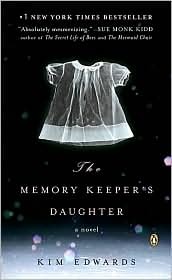
The Memory Keeper's Daughter by Kim Edwards

(Photo taken from Goodreads)

Title: The Memory Keeper's Daughter
Author: Kim Edwards
Publisher: Penguin
Language: English
ISBN - 10: 0143037145
ISBN - 13: 978-0143037149
Rating:


Dear Ms. Edwards,

I hope you are well. I have read your book, The Memory Keeper's Daughter, and this letter was written to tell you what I think about it. You probably don't have much time to reply to letters to you, even read them, but I just wanted to get this off my chest.

I got a copy of your book because I was very intrigued by the premise of the plot: A young woman Norah, in the '60s, gave birth to twins with only her orthopedic surgeon husband, David, and Caroline, a nurse, to attend to her labor. The first child, a baby boy, was perfect and healthy; but the next child, a girl, was born with Down syndrome. David then made a hasty decision to ask Caroline to take the baby girl, Phoebe, to an institution. Caroline, however, decided to take care of Phoebe and disappeared. I liked what you wanted to do with the story, to show how one lie can insidiously destroy a family, the difficulties of having a child with Down syndrome in the 1960s, and a mother's pain in losing a child.

I was very intrigued that going through several pages, I had a false sense of excitement for this book, not noticing that the story was sort of imbalanced. You kept telling us about how David or Norah or Caroline feels, but never showing us how. I wanted to cry with Norah and with David, but I just can't because it felt like you were just telling me to cry, instead of showing me a reason to cry. It felt imbalanced when you kept telling me about how Caroline had to fight a lot to help Phoebe get a normal life, instead of showing me what those fights were. I can see that you are a good story teller, but I hope that in other books, you can prove that you are also good with story imaging.

As for the characters, I could not see much depth, except for Phoebe, which is probably because you decided that a girl with Down syndrome should be portrayed skillfully to become realistic - which shows that you do have talent for character creation, but you seem to become too engrossed with your storytelling than bother with the other characters. Somehow, it appears, that your sympathy for Phoebe's plight overshadowed your writing, that you felt you wanted to lash out on the other characters, especially David's family by making them appear unlikeable, stereotypical, and bland. There was no credibility in their characters, each of their actions and histories questionable: David's past should have made him more of a man instead of the coward you made him out to be; Norah's intentions when she agreed to marry David did not seem to be out of love, but more like she just married a man like him who could give her the stability she wanted. Paul, pining for how life would be like if his sister lived, felt like he's just reacting to whatever his parents did, not having his own personality.

But in spite of those flaws, I did enjoy your book and even felt as trapped as David in keeping those lies. But to say that I loved all of it would be a lie: for me, the first and last parts are the only good ones. The premise of the plot was unique and remarkable, but the plot itself, not very much. And as I got closer to the end, it did not bother me that much.

Please don't take this personally. I only wanted to comment on the story you wrote, and I hope this would help you in writing your next book. I look forward to another unique story from you, and when that time comes, I hope it will be way better than this one.


Sincerely,


Wednesday, November 24, 2010

The God of Small Things by Arundhati Roy

(Photo taken from Wikipedia)

Title: The God of Small Things
Author: Arundhati Roy
Publisher: Harper Perennial
Language: English
ISBN - 10:
0060977493
ISBN - 13:
978-0060977498
Rating
:


The Story According to the Blurb

"The story of the tragic decline of an Indian family whose members suffer the terrible consequences of forbidden love, The God of Small Things is set in the state of Kerala, on the southernmost tip of India. Armed only with the invincible innocence of children, the twins Rahel and Esthappen fashion a childhood for themselves in the shade of the wreck that is their family - their lonely, lovely mother (who loves by night the man her children love by day), their blind grandmother, Mammachi (who plays Handel on her violin), their beloved uncle Chacko (Rhodes scholar, pickle baron, radical Marxist, bottom-pincher), their enemy, Baby Kochamma (ex-nun and incumbent grandaunt), and the ghost of an imperial entomologist's moth (with unusually dense dorsal tufts)."

"When their English cousin and her mother arrive on a Christmas visit, the twins learn that Things Can Change in a Day. That lives can twist into new, ugly shapes, even cease forever..."


Thoughts

Have you ever had a dream in which everything was almost too real, you could not quite believe it when you have to wake up?


That was exactly how I would describe this book. The narration is startlingly vivid, that I can almost say I was with Rahel and Estha the whole time, crossing the river with them, listening to them make plans in the pickle factory, carrying their boat above our heads. Albeit slow, the story builds up to paint a big picture from the seemingly small things that the twins and their family encounter. Every single event is explored, every minute detail a metaphor. The writing draws a fine line between the well-drawn and the verbose. It was like gossiping with housewives - telling you a story in a non-linear way with exhausting description, that you always end up asking them to hurry up already and get to the juicy parts, only realizing that to fully appreciate the punchline, every inch of the story has to be exposed.

But unlike gossiping housewives, the author exhibits finesse and intelligence with the way she dealt with the story. Seen through the eyes of the young two-egg twins, their childish wisdom demonstrates an innocent, but not oversimplified, view of themselves, their family and their home. The author provides a credible portrait of two children amidst familial and social struggles that cause them to grow up unspeaking (Estha) and unfeeling (Rahel).

Each character's personalities are also very well-accounted for, that one can empathize with Ammu's plight, laugh at Chacko's quirks, and loathe Baby Kochamma with alarming intensity. Aided with realistic imagery, not just once did I find myself touching my feet at the mention of Baby Kochamma's edematous ones, disgust at the OrangedrinkLemondrink man; I even found myself singing with Estha while inside the Abhilash Talkies. They were almost real I expected a crowd to shush me when I sang.

From my point of view, this is a rediscovery of the trauma that the twins suffered while growing up, and they remembered it through the small things seemingly insignificant, but grew to be the cornerstone of their pain. The pain that in the self-centeredness of childhood, they claimed to be their doing, but with the passing time and the maturity of their minds, they understood that it was not their fault, and they were given their chance to grieve for their loss. Although some would object at the turn of events in the end, I myself could not complain, especially as I am not the one keeping the 'Love Laws,' "That lay down who should be loved. And how. And how much."