

Showing posts with label psychology. Show all posts

Tuesday, February 8, 2011

Book Review: Still Alice By Lisa Genova

Photo taken from Goodreads

 Book Info

Title:  Still Alice 

Author:  Lisa Genova
Publisher:  Pocket Books
Language: English
Format:  Paperback 
Pages:  337 pages
ISBN-10:  1439170045
ISBN-13:  978-1439170045
Source:  Purchased, National Bookstore
 
Summary

From Goodreads:
 

"Alice Howland is proud of the life she worked so hard to build. At fifty years old, she's a cognitive psychology professor at Harvard and a world-renowned expert in linguistics with a successful husband and three grown children. When she becomes increasingly disoriented and forgetful, a tragic diagnosis of early-onset Alzheimer's disease changes her life.

As the inevitable descent into dementia strips away her sense of self, fiercely independent Alice struggles to live in the moment. While she once placed her worth and identity in her celebrated and respected academic life, now she must reevaluate her relationship with her husband, a respected scientist; her expectations of her children; and her ideas about herself and her place in the world.

At once beautiful and terrifying, Still Alice is a moving and vivid depiction of life with early-onset Alzheimer's disease that is as compelling as A Beautiful Mind and as unforgettable as Ordinary People.
"


Review

I have been eyeing this book for the longest time!  When I read about this, I searched every bookstore I could visit but could not find a single copy.  I thought of getting a copy online but I was too cautious about spending on books with my credit card because I might end up with an exorbitant book debt.  So this has been on my wish list for the longest time, until I came to this bookstore in a place I don't usually go to, and there I saw it, a copy of this book and it was all I could do to keep from jumping for joy, I was so excited!

On to the review.  Because of what I have been reading about this, I had very high expectations for this book, and I am very glad that it did not disappoint.  This book was about Alice who had Early-Onset Alzheimer's Disease and how she lived out the remaining lucid days she had.  Genova had utilized her neuroscientist background to paint a very scientific yet emotional picture of Alice Howland and how her life plays out when she discovered that she had the disease.  For a renowned Harvard professor, noted for the sharpness of her brain, her intelligence, and her success as an educator, this was such a big blow and it translated well on the pages.  The occasional mention of events that were inconsistent with what actually happened even solidified the evidence of Alice's mental decline.  The book was narrated by third person but mostly seen through Alice's eyes, which provided the readers with an all-encompassing view of what was happening to Alice as if they were experiencing it themselves.  

Dialogue between the characters were used economically and sparingly, but every bit significant in contributing to a more potent painting of the situation with Alice.  Her family, her colleagues, her whole social circle were portrayed as that of real people who have an Alzheimer's patient in their midst.  Intelligently-written but very simple conversations would evoke empathy on every reader, especially for Alice's children.  Alice's husband alternated between denial and acceptance throughout the story and although it sometimes showed him as unfeeling and brutal, you could still sympathize with him as a very aggrieved husband.  As for Alice's children, their fears and dreams were given ample attention but not too much that they overshadowed their mother's story.  Even their occasional bickering was a bit humorous to read about as it was effectively written to sound as if real adults were speaking, and in a real world.

I liked how the author wrote this story with a very strong and successful woman as a subject.  It helped quell some myths about Alzheimer's, especially those about the susceptibility to this disease.  It showed how this illness does not just affect older people, but may also attack the brains of young, active individuals.  It also taught readers a lesson not to base your self-worth on your career.  Alice Howland was a successful Harvard professor, therefore, she was a successful human being.  But when Alzheimer's struck, she herself doubted her own abilities and her self-esteem dropped.  Eventually she found herself appreciating the simple things in life, like eating ice cream while walking in the streets on a sunny day. 

Although this book would ultimately sound a bit sad as we know that there are still no happy endings when it came to Alzheimer's, the tone of this book was actually very hopeful and happy as it narrated to us the story of Alice as she struggled with her disease and learned to live for the present and be proud of what she was and happy for what she still had.

A day after finishing this book, I visited this bookstore that I usually go to, and there on the shelves were two copies of this book. 

Rating


If you have any questions on this particular rating, please refer to my ratings system here.

Notice 

All opinions expressed in this book review are my own and not influenced by any party in any way. 

Please contact me for questions, comments, and suggestions. 

Thursday, December 9, 2010

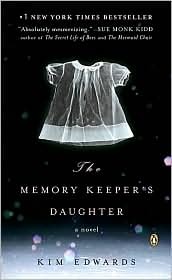
The Memory Keeper's Daughter by Kim Edwards

(Photo taken from Goodreads)

Title: The Memory Keeper's Daughter
Author: Kim Edwards
Publisher: Penguin
Language: English
ISBN - 10: 0143037145
ISBN - 13: 978-0143037149
Rating:


Dear Ms. Edwards,

I hope you are well. I have read your book, The Memory Keeper's Daughter, and this letter was written to tell you what I think about it. You probably don't have much time to reply to letters to you, even read them, but I just wanted to get this off my chest.

I got a copy of your book because I was very intrigued by the premise of the plot: A young woman Norah, in the '60s, gave birth to twins with only her orthopedic surgeon husband, David, and Caroline, a nurse, to attend to her labor. The first child, a baby boy, was perfect and healthy; but the next child, a girl, was born with Down syndrome. David then made a hasty decision to ask Caroline to take the baby girl, Phoebe, to an institution. Caroline, however, decided to take care of Phoebe and disappeared. I liked what you wanted to do with the story, to show how one lie can insidiously destroy a family, the difficulties of having a child with Down syndrome in the 1960s, and a mother's pain in losing a child.

I was very intrigued that going through several pages, I had a false sense of excitement for this book, not noticing that the story was sort of imbalanced. You kept telling us about how David or Norah or Caroline feels, but never showing us how. I wanted to cry with Norah and with David, but I just can't because it felt like you were just telling me to cry, instead of showing me a reason to cry. It felt imbalanced when you kept telling me about how Caroline had to fight a lot to help Phoebe get a normal life, instead of showing me what those fights were. I can see that you are a good story teller, but I hope that in other books, you can prove that you are also good with story imaging.

As for the characters, I could not see much depth, except for Phoebe, which is probably because you decided that a girl with Down syndrome should be portrayed skillfully to become realistic - which shows that you do have talent for character creation, but you seem to become too engrossed with your storytelling than bother with the other characters. Somehow, it appears, that your sympathy for Phoebe's plight overshadowed your writing, that you felt you wanted to lash out on the other characters, especially David's family by making them appear unlikeable, stereotypical, and bland. There was no credibility in their characters, each of their actions and histories questionable: David's past should have made him more of a man instead of the coward you made him out to be; Norah's intentions when she agreed to marry David did not seem to be out of love, but more like she just married a man like him who could give her the stability she wanted. Paul, pining for how life would be like if his sister lived, felt like he's just reacting to whatever his parents did, not having his own personality.

But in spite of those flaws, I did enjoy your book and even felt as trapped as David in keeping those lies. But to say that I loved all of it would be a lie: for me, the first and last parts are the only good ones. The premise of the plot was unique and remarkable, but the plot itself, not very much. And as I got closer to the end, it did not bother me that much.

Please don't take this personally. I only wanted to comment on the story you wrote, and I hope this would help you in writing your next book. I look forward to another unique story from you, and when that time comes, I hope it will be way better than this one.


Sincerely,


Monday, November 22, 2010

House Rules by Jodi Picoult

(Photo taken from Jodi Picoult's website)


Title: House Rules
Author: Jodi Picoult
Publisher: Atria International
Language: English
ISBN - 10:
0743296443
ISBN - 13: 978-0743296441
Rating
:


House Rules:

  1. Clean up your messes
  2. Tell the truth
  3. Brush your teeth twice a day
  4. Don't be late for school
  5. Take care of your brother; he's the only one you've got.
Those are house rules set up by Emma Hunt, mother of Jacob and Theo. She has been burdened since Jacob was two years old by responsibility for Jacob's condition. He has Asperger's syndrome, making him, although exhibiting exceptional intelligence, hopeless in expressing himself well and reading social cues. His interest in forensic analysis has made him a fixture in police crime scenes, telling them what to do which usually turns out right. However, when a friend was murdered, the police suspect him and take his Asperger's symptoms to imply guilt.

I read an interview of Picoult regarding this new book here and it was good that she really did her homework with regards to Asperger's syndrome, forensic analysis, and the legal issues involved. However, if I were to do like Jacob and pretend that this novel is a CrimeBusters episode, I'd say I solved the murder just right after Chapter 2. A murder mystery this is not; I'd like to think this is more of a-love-between-brothers story, or an-inside-look-into-the-Asperger's-syndrome, or better yet, a simple family's love and struggle for normalcy amid mental/psychological illness.

Most of the time, I wonder about what other people think while they are doing something. What is going through the butcher's head while cutting a pig open; or what a mother thinks about while slapping a wayward child's face? This novel definitely provides a lot of insight into each of the character's heads, even Jacob's. I like the depth of her imagination, that she was able to give a good impression of what's running inside an aspie's head; but it is not only imagination that she was able to pull it off properly, her research gave a lot of credibility into her words.

Story-wise, I thought the pacing was very good, and I like the sprinkling of real-life murder cases in some parts, all of which are trying to say, "It's not what it seems." It encouraged the readers to really dig deeper and use their imaginations to figure out what is going to happen. I really think that the author wanted the reader to solve the mystery, but it would have been better if she added another twist or so, that way maybe I wouldn't have been able to solve the murder earlier, and prolonged the suspense more.

The character development is also satisfying. I like how Emma, the mother, the one who devoted her whole life for Jacob's well-being, was finally able to recognize and fulfill her own needs but not ignoring her responsibilities. I like how Theo finally found the answers to his questions, and dissolved his desire to become apathetic to his brother's plight.

Overall, this book is very insightful, informative, and interesting. The characters are very lovable, even Theo in all his teenage angst. This is a book worth reading and re-reading with the rest of your family that will definitely draw you closer and appreciate the compassion that you give each other.